Sentier du gypse et de Sainte-Madeleine
Add to my favorites

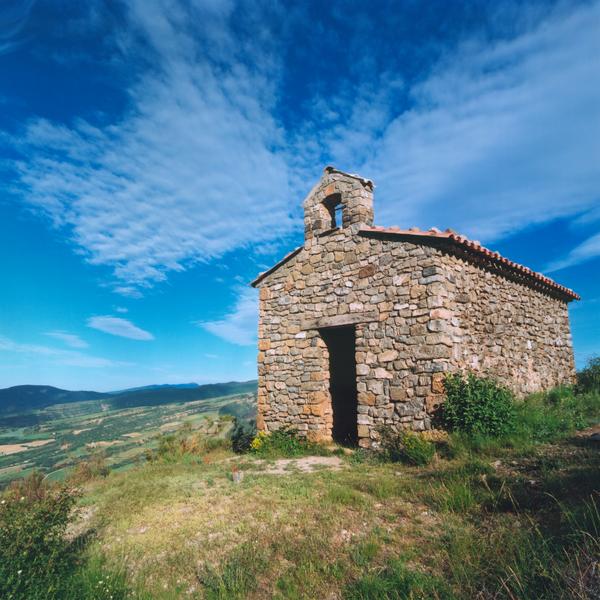
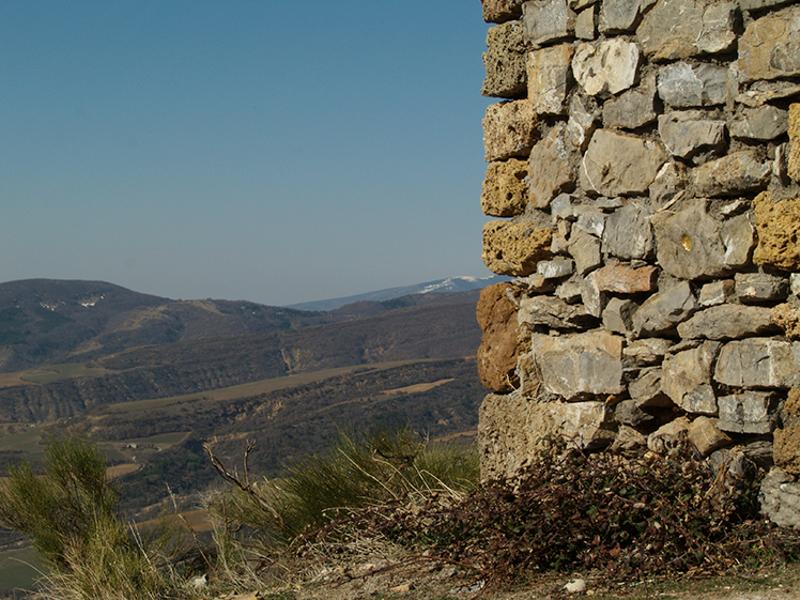
Perched on the rock of Sainte-Madeleine overlooking the Duyes valley and the village of Thoard, the chapel of the same name, dating from 1657, was completely restored in 2002 by the artist Andy Goldsworthy, it is part of the work Refuge d'Art.
The characteristics of the route.

Thoard (04)
- Distance 3.72 km
- Elevation gain 240 m
- Elevation lost 240 m
- Min. elevation 951 m
- Max. elevation. 1137 m
- Duration (depending on pace) 2h
- Suivre le balisage Yes

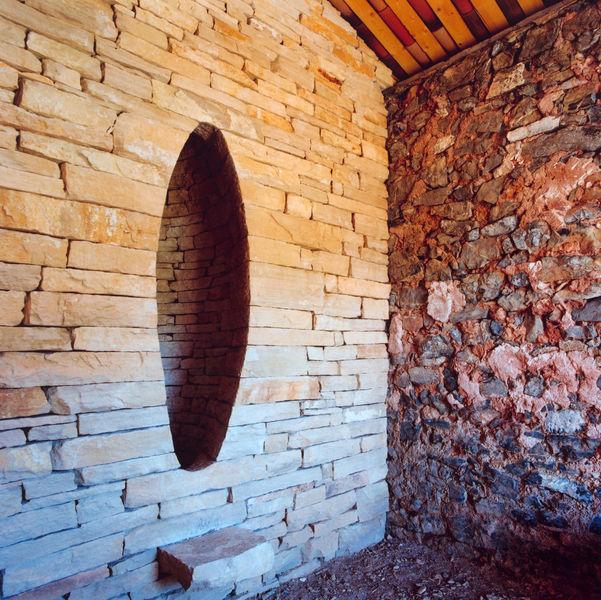
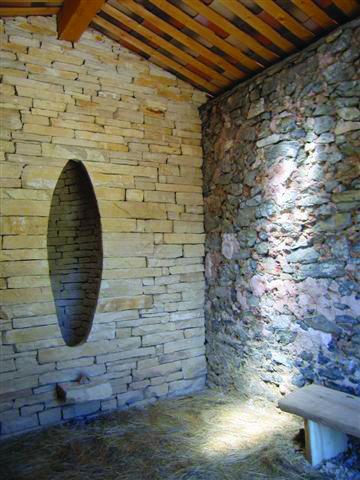
Don't hesitate to enter the chapel, Andy Goldsworthy** intervenes here on the entire building. The back wall is lined with a regular arrangement of cut stones in the center of which an egg-shaped cavity allows one to stand. This is where "others have stood before, and where others will stand after", says the artist. He designs this penetrable device as a case that preserves the memory of visitors, witness to their presence, but also to their absence in this place.
**Andy Goldsworthy (Sale Moor, England, 1956) places nature at the heart of his work. But without reducing his works to natural materials, nor to the natural processes that pass through them, he takes into account the nature of the place and its history. This explains why Andy Goldsworthy works mainly in places marked by human presence.
Refuge d’Art a single work of art to be covered in about ten days of walking. Today it consists of seven refuges and three Sentinels connected by a path. Originally, old abandoned farm buildings, a ruined chapel, collapsed shepherd's huts... founded the project of their restoration by the artist, in order to accommodate a work of art and shelter walkers and hikers.
On the facade of the chapel, look for a golden dot, engraved in the stone. This is point, by the artist herman de vries* (2009). For the artist, the simplicity of the point prohibits any interpretation, it captures the attention of the walker, to question him and invite him towards other thoughts. No matter where you are or where you are going, point invites you to go further! herman de vries* is a naturalist by profession. His view of the world is strongly influenced by oriental philosophy. For him, nature is sufficient in itself and does not need to be embellished by art: "nature is art", he says, because it is perpetual creation.
* we respect the artist's wish not to use capital letters, a form of hierarchy.
Formed about 220 million years ago in a salty lagoon, gypsum is a soft rock composed of calcium sulfate. Heated in a kiln, it loses its water by evaporation and turns into plaster. Then, after being ground in the open air or in a mill, it can be rehydrated and used in construction. In the 1840th century, many small extraction sites existed in Haute-Provence. Traditional architecture offers multiple uses for plaster: from the coarsest used as mortar for building walls to the finest used for making plasterwork. In Thoard, gypsum quarries have been documented since 1890, but extraction probably began much earlier. The best known is the Siron quarry, mentioned from 1940, which was exploited until XNUMX. The stone was extracted in the open air with a pickaxe and mattock, then loaded onto sleds commonly used in the valley for agricultural work on steep slopes. It was thus transported to the village to the plaster factory. There, a mill powered by hydraulic energy, created by a fall on the Riou torrent, operated a heavy vertical stone millstone.
**Andy Goldsworthy (Sale Moor, England, 1956) places nature at the heart of his work. But without reducing his works to natural materials, nor to the natural processes that pass through them, he takes into account the nature of the place and its history. This explains why Andy Goldsworthy works mainly in places marked by human presence.
Refuge d’Art a single work of art to be covered in about ten days of walking. Today it consists of seven refuges and three Sentinels connected by a path. Originally, old abandoned farm buildings, a ruined chapel, collapsed shepherd's huts... founded the project of their restoration by the artist, in order to accommodate a work of art and shelter walkers and hikers.
On the facade of the chapel, look for a golden dot, engraved in the stone. This is point, by the artist herman de vries* (2009). For the artist, the simplicity of the point prohibits any interpretation, it captures the attention of the walker, to question him and invite him towards other thoughts. No matter where you are or where you are going, point invites you to go further! herman de vries* is a naturalist by profession. His view of the world is strongly influenced by oriental philosophy. For him, nature is sufficient in itself and does not need to be embellished by art: "nature is art", he says, because it is perpetual creation.
* we respect the artist's wish not to use capital letters, a form of hierarchy.
Formed about 220 million years ago in a salty lagoon, gypsum is a soft rock composed of calcium sulfate. Heated in a kiln, it loses its water by evaporation and turns into plaster. Then, after being ground in the open air or in a mill, it can be rehydrated and used in construction. In the 1840th century, many small extraction sites existed in Haute-Provence. Traditional architecture offers multiple uses for plaster: from the coarsest used as mortar for building walls to the finest used for making plasterwork. In Thoard, gypsum quarries have been documented since 1890, but extraction probably began much earlier. The best known is the Siron quarry, mentioned from 1940, which was exploited until XNUMX. The stone was extracted in the open air with a pickaxe and mattock, then loaded onto sleds commonly used in the valley for agricultural work on steep slopes. It was thus transported to the village to the plaster factory. There, a mill powered by hydraulic energy, created by a fall on the Riou torrent, operated a heavy vertical stone millstone.
Area : Digne-les-Bains
Report a problem
THIS ROUTE IN YOUR MOBILE PHONE
Download Provence Alpes Outdoor app
Get all the routes on your smartphone with the Provence Alpes outdoor app. You'll find a host of functions :
- Take advantage of detailed IGN maps
- Download data for consultation even when you're not connected to the network
- Geolocate yourself at any time on the route and altimeter profile
- Activate the off-track alarm to be alerted if you stray from the itinerary
- Find nearby services
- Share your experience (add a report, share your lap time)...


FFFP
finished in 02:00:00
The 2026/02/22
En savoir plus
Ajouter votre chrono et partager vos sensations
2026/02/22 02:00:00
FFFP
FFFP
Bonjour, joli parcours, cependant les genêts ont envahis le sentier, cela "caresse" les jambes des adultes mais pour les enfants c'est moins agréable, ils ont la végétation à hauteur d'épaules, plus difficile pour eux de progresser. Le printemps approchant il serait bon de l'entretenir. Merci
2026/02/22 02:00:00
FFFP
FFFP
Bonjour, joli parcours, cependant les genêts ont envahis le sentier, cela "caresse" les jambes des adultes mais pour les enfants c'est moins agréable, ils ont la végétation à hauteur d'épaules, plus difficile pour eux de progresser. Le printemps approchant il serait bon de l'entretenir. Merci


Information updated on 2026-06-01 by Office de Tourisme Provence Alpes Digne les Bains


Provence Alpes Digne-les-Bains tourist office
+ 33(0)4 92 36 62 62
Tourist office
contact mail
Val de Durance – Château-Arnoux tourist office
+33 (0)4 92 64 02 64
Tourist office
contact mail

Moustiers-Sainte-Marie Tourist office
+ 33(0)4 92 74 67 84
Tourist office
contact mail
Seyne - Blanche Serre-Ponçon Tourist office
+33 (0)4 92 35 11 00
Tourist office
contact mail
 Provence Alpes Outdoor - Parcours - Sentier du gypse et de Sainte-Madeleine
Hello, world! This is a toast message.
Provence Alpes Outdoor - Parcours - Sentier du gypse et de Sainte-Madeleine
Hello, world! This is a toast message.
Provence Alpes Outdoor - Parcours - Sentier du gypse et de Sainte-Madeleine
Hello, world! This is a toast message.


OK
Annuler